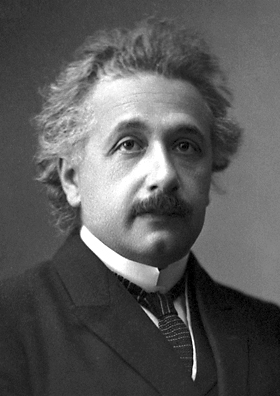
Learning from the Life and Work of Albert Einstein …
How he learned, How He Mastered His Field [Med. Gray]
When Albert Einstein was a child, his parents feared that he might have a mental deficiency. He early efforts at language were a struggle. When he was in high school, he was not a great student. His grades were mediocre, he disliked the conventional ways subjects were taught, and he hated rote learning. After high school, he studied at the Zurich Polytechnic and when he graduated in 1900, he was near the bottom of his class. Does this sound like someone you would peg as a genius? How can we account for the fact that he would go on to make extraordinary discoveries in physics that would ultimately transform the world? The answer has a lot to do with his near-infinite curiosity.
His Curiosity, and What Drove It [RGB 186 x3]
[I think you need to stick with your basic three-part model] [This is a chance to showcase the importance of curiosity. This is where you would put: At the age of __, the young Albert Einstein received a compass as gift. He couldn’t put it down.
His Why: What Inspired Him, how he defined his purpose [Gray]
THIS is where you bring in ‘Inspired Purpose’ … a bigger-than-you purpose.
How He Thought Different
Few people realize this, but one of the most consistent patterns in Einstein’s thinking was his insistence on reducing complex questions down to simple, concrete visuals.
How He Collaborated
What He Did that Advanced the World
How He Did It
How He Persisted in the face of Difficulties
Read More …
Credits: