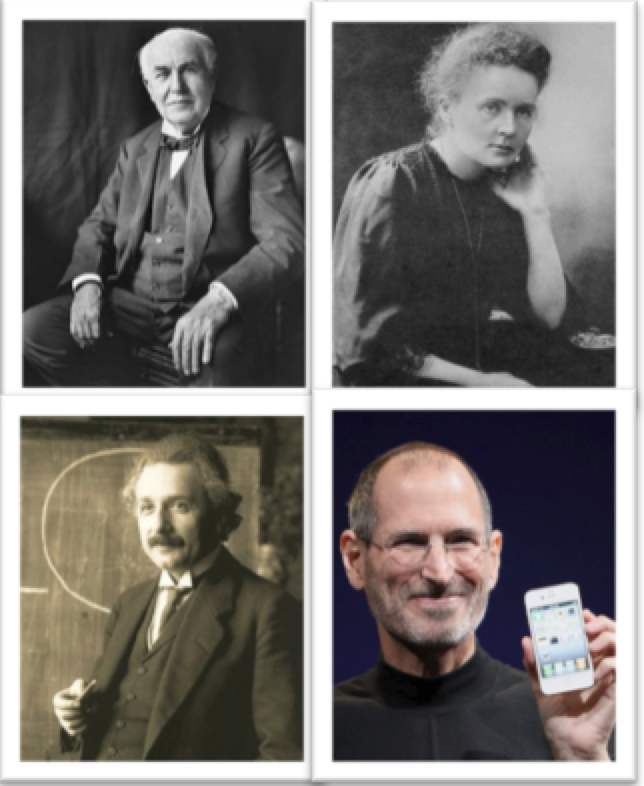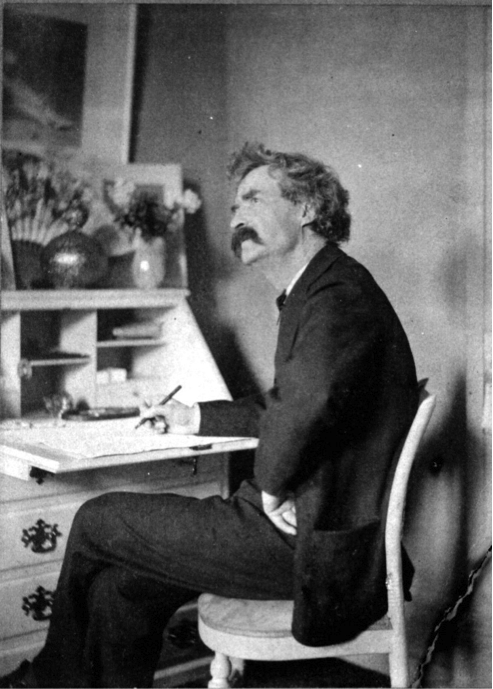
Imagination and Creativity Illustrated: Mark Twain at his Writing Desk
These four words today are used often. They’re used interchangeably and some say they’re overused. But they’re also here to stay. So it would be good to get to know them better. Here’s a quick look at how leading experts have defined them.
Design – and Design Thinking
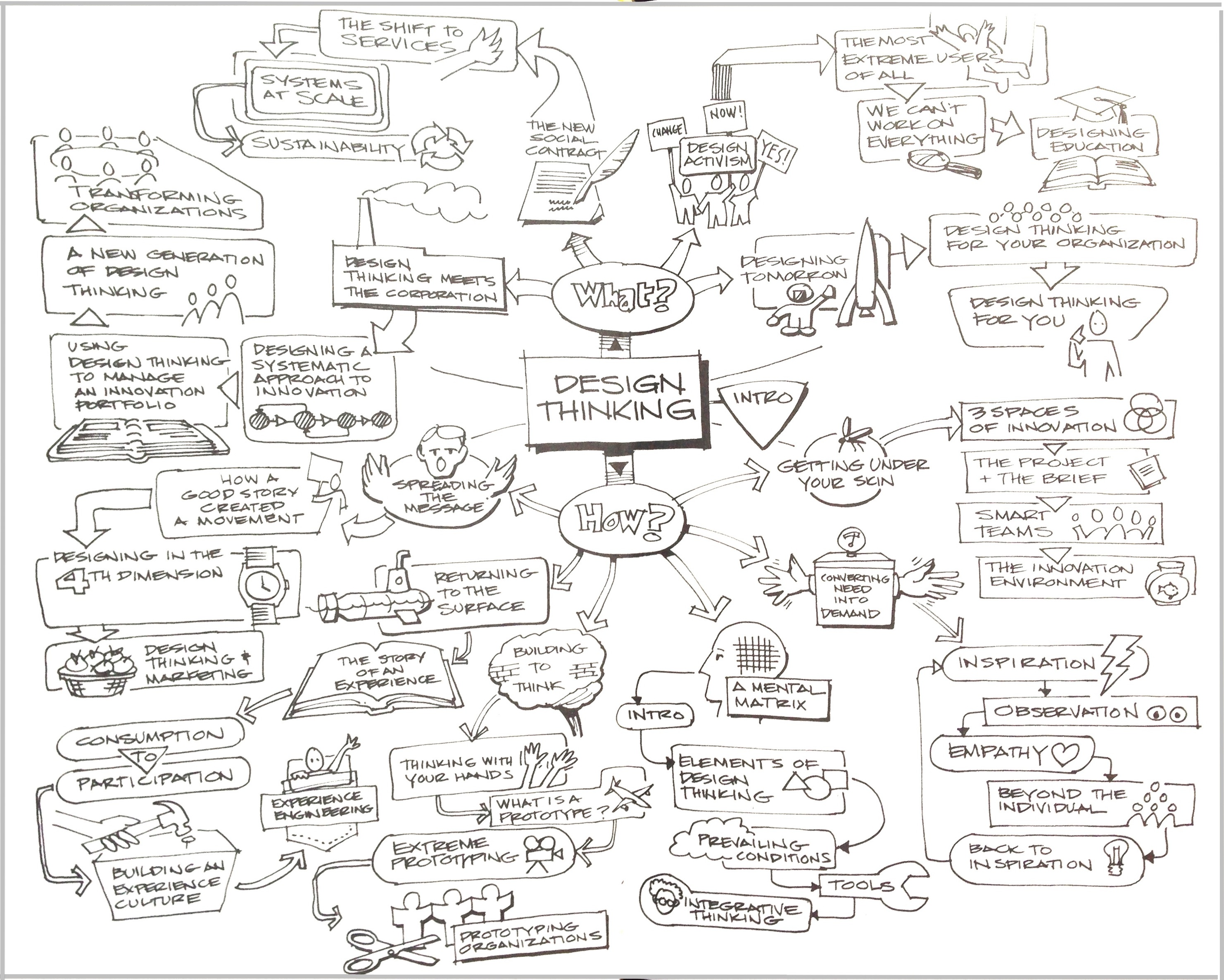
Tim Brown, David Kelley and Tom Kelley from design firm IDEO have been leaders in the movement that transformed “design” as artistic work into “design thinking” as a process. Here is how they describe design thinking:
“Design thinking is a way of finding human needs and creating new solutions using the tools and mindsets of design practitioners.” “Being human-centered is at the core of our innovation process. Deep empathy for people makes our observations powerful sources of inspiration.” Design thinking is thus “a methodology … [it is] our process for creativity and innovation.” [ref] Tom Kelley and David Kelley, Creative Confidence (New York: Random House, 2013), pp. 21-25 [/ref]
To produce design-driven innovation, IDEO developed their methodology into a 4-step process: 1. Inspiration – which is primarily the step of “connecting with the needs, desires, and motivations of real people [to help] inspire and provoke fresh ideas”; 2. Synthesis – which is the challenge of “sense-making” – reframing the problem and observations to identify the possible solutions; 3. Ideation and Experimentation – the step of testing, experimenting and finalizing; and 4. Implementation.
Imagination
In his book Out of Our Minds, Sir Ken Robinson broke the whole process down into three parts: imagination, creativity and innovation. Here’s how he described imagination:
“Imagination is the source of our creativity”. Indeed, “every uniquely human achievement in every field” is the “product of the human imagination.” It’s “the ability to bring to mind things that are not present to our senses. We can imagine things that exist or things that do not exist at all.” It is the “primary gift of human consciousness.” In imagination “we can anticipate many possible futures.” The imagination “liberates us from our immediate present circumstances and holds the constant possibility of transforming the present.”[ref]Sir Ken Robinson, Out of Our Minds (UK: Capstone Publishing, 2011), pp. 141-42.[/ref]
Imagination and creativity “are not the same thing,” Robinson stresses. “Creativity is a step further on from imagination,” and this leads to …
Creativity
Creativity is a step further on from imagination, because it involves a lot more than just being imaginative. It is:
“the process of having original ideas that have value.” Being creative “involves doing something. It would be odd to describe someone as creative who never did anything. … Creativity involves putting your imagination to work
Creativity is thus a process, and Robinson says the three key words in the definition are process, original, and value. The process, simply put, is about generating ideas and then sifting the ones that are original and have value from those that don’t.
How does this differ from innovation? “Innovation is applied creativity,” he says, which leads to …
Innovation
According to Robinson:
“Innovation is the process of putting new ideas into practice. … By definition, innovation is always about introducing something new, or improved, or both and it is usually assumed to be a positive thing.”[ref]Out of Our Minds, p. 142.[/ref]
Peter Drucker, in The Discipline of Innovation defined innovation in similarly broad terms:
“What all successful entrepreneurs
In both definitions, innovation clearly is not just new products or inventions: it’s bringing about purposeful, focused change that has value in practice, in any sphere of society.
Putting It All Together
Putting all the above together, what the above definitions have in common is that innovation is a process.
Whether you call it design thinking or some other term, it’s the process of transforming ideas from your imagination into a creative output or solution that has value and thus amounts to an innovation.
What’s the upshot? The simple upshot is that everyone already has the first two: You already have an imagination. And you already have a process (it’s whatever you do routinely each day).
The question is whether you are tapping your imagination to actually become creative, and whether you’re using that creativity to produce new solutions that have value. In other words, whether you learned … to think like an innovator. It’s a choice we all make, as individuals, and as a society, every day.
D.G.